Market Analysis

AI in Prop Trading: How Algorithms are Changing the Game

Exploring how machine learning models, neural network predictions, and automated trading bots are reshaping proprietary trading — and what it means for the future of retail funded traders in 2026 and beyond.

Sam Chen

Tech Analyst

calendar_todayJan 5, 2026
schedule6 min read
Share:
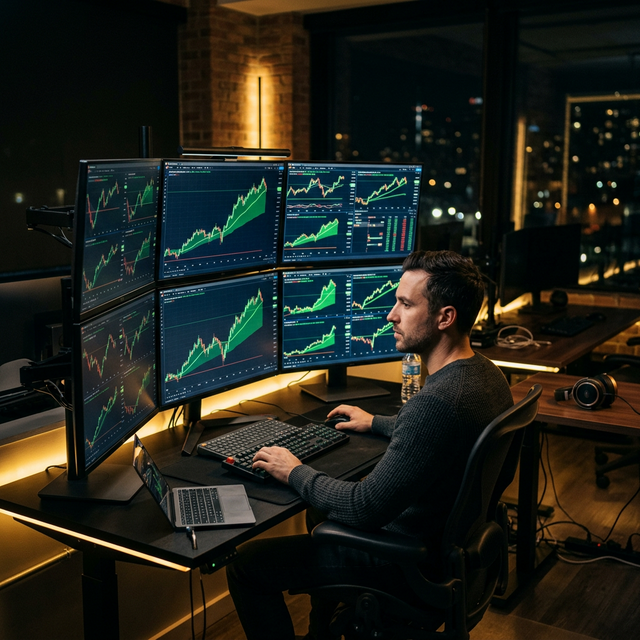
AI trading algorithms on futuristic displays
keep

Key Takeaways

  • check_circle

    40% of prop firm traders now use some form of algorithmic assistance in their trading decisions.

  • check_circle

    Machine learning models can analyze 10,000x more data points than human traders in real-time.

  • check_circle

    Most prop firms allow algorithmic trading with specific latency and trade frequency constraints.

  • check_circle

    The human-AI hybrid approach outperforms both pure discretionary and pure algorithmic trading.

1. The Current AI Trading Landscape

Artificial intelligence has gone from a buzzword to a genuine competitive advantage in prop trading. In 2024, institutional trading desks allocated an estimated $12 billion to AI-driven strategies. By 2026, that number has nearly doubled. But what's more interesting for retail prop traders is the democratization of these tools — what once required a PhD in quantitative finance and a Bloomberg terminal now runs on a laptop with Python and a TradingView API key.
The shift isn't just about speed anymore. Modern AI trading tools fall into three distinct categories: predictive analytics (forecasting price movements), execution optimization (improving entry and exit timing), and risk management (automated drawdown protection and position sizing). Understanding where each fits into your workflow is crucial for leveraging AI effectively without becoming dependent on it.
query_stats

Predictive Analytics

ML models forecasting price, volatility, and momentum

speed

Execution Optimization

Smart order routing, slippage reduction, optimal timing

shield

Risk Management

Automated stops, position sizing, drawdown protection

lightbulb

Pro Tip

"The best AI trading tools don't replace your decision-making — they augment it. Use AI for what it's good at (pattern recognition, speed, data processing) and use your human judgment for what AI can't do (understanding market context, adapting to regime changes, and managing novel situations)."

2. Machine Learning Models for Traders

Not all ML models are created equal, and most retail traders don't need the complexity of deep learning neural networks. In practice, the simplest models often outperform complex ones because they're less prone to overfitting — a critical problem where the model "memorizes" historical data instead of learning genuine patterns.
  • Random Forest Classifiers: Excellent for binary decisions (trade/no-trade). Can process hundreds of features including price action, volume, order flow, and sentiment indicators.
  • LSTM Neural Networks: Specialized for sequential data. Best for predicting next-bar direction based on the last 50-100 bars of price action and volume.
  • XGBoost / LightGBM: The workhorses of competitive ML. Fast training, excellent accuracy, and built-in feature importance ranking tells you which indicators actually matter.
  • Reinforcement Learning (RL): Advanced agents that learn optimal trading policies through simulated market environments. High ceiling but requires significant computational resources.

3. AI Trading & Prop Firm Compliance

Before deploying any algorithmic strategy on a prop firm account, you need to understand the compliance landscape. Most firms allow algorithmic trading, but with specific restrictions that can vary significantly between providers. Violating these rules — even accidentally — can result in immediate account termination without appeal.
  • FTMO: Allows EAs (Expert Advisors) on MT5. No high-frequency trading (HFT). Minimum 2-second hold time per trade.
  • Apex Trader Funding: Allows automated trading on supported platforms. No copy-trading from other funded accounts. No latency arbitrage.
  • Tradeify: Allows all trading styles including bots. No news-spike scalping within 30 seconds of major releases.
  • MyFundedFX: EA-friendly with restrictions on trade frequency (max 200 trades/day). Requires manual oversight declaration.
warning

Critical Warning

Never deploy an untested algorithm directly on a prop firm evaluation. Always backtest on at least 2 years of historical data, forward-test on a demo account for 30+ days, and verify that your strategy complies with all firm-specific rules before risking evaluation capital.

4. The Human-AI Hybrid Approach

Our research shows that the most successful prop firm traders in 2026 aren't fully automated or fully discretionary — they use a hybrid approach. The AI handles signal generation, scanning for setups across multiple timeframes and instruments simultaneously. The human provides the context filter, deciding which signals to act on based on broader market conditions, news flow, and experience-based intuition.
A practical hybrid workflow looks like this: your algorithm scans 50+ instruments every 5 minutes, scoring each based on your criteria (momentum, mean reversion, breakout probability). It presents you with a ranked list of the top 5 opportunities. You review each one, apply your contextual filter (Is there a major news event? Is overall market sentiment aligned? Is this a historically reliable setup?), and then execute the best 1-2 trades manually. The AI does the heavy lifting of data processing; you make the final call.

5. Essential AI Tools for Prop Traders

You don't need to build everything from scratch. The AI trading ecosystem has matured significantly, and there are now accessible tools for every skill level. Here are the most impactful ones for prop firm traders:
  • TradingView Pine Script + Alerts: Start here. Pine Script v5 supports basic ML-inspired indicators. Use webhook alerts to trigger semi-automated entries via broker APIs.
  • Python + pandas + scikit-learn: The standard stack for building custom ML models. Free, well-documented, and supported by a massive community.
  • QuantConnect / Lean: Cloud-based backtesting platform with live trading capabilities. Supports Python and C#, integrates with multiple brokers.
  • ChatGPT / Claude API: Use LLMs for sentiment analysis of financial news, earnings calls, and social media. The latest models can reliably classify market sentiment from text data.

6. The Future of AI in Prop Trading

The trajectory is clear: AI will become an integral part of every serious trader's toolkit within the next 2-3 years. The firms that survive will be those who embrace AI as a complement to human judgment, not a replacement for it. For prop traders specifically, the competitive advantage will shift from pure technical analysis skill to the ability to build, evaluate, and manage AI-assisted trading systems.
Our recommendation: Start small. Learn Python basics, build a simple moving average crossover backtester, then gradually add complexity. Don't try to build a GPT-powered autonomous trading bot as your first project. The traders who succeed with AI are the ones who understand both the capabilities and the limitations of the technology. AI is a powerful amplifier — but it amplifies bad strategies just as effectively as good ones.
Sam Chen

Sam Chen

Tech Analyst & Quant Developer

Sam is a former quantitative developer at a Tier-1 hedge fund, now writing about the intersection of AI and retail trading. He specializes in making complex algorithmic concepts accessible to prop traders.

Share this Insight

menu_book Related Articles

View all arrow_forward

mail Get Weekly Trading Insights

Join 5,000+ traders for the latest market edge, firm reviews, and exclusive strategy updates.

mail
lock No spam, unsubscribe anytime.
check_circle Copied!