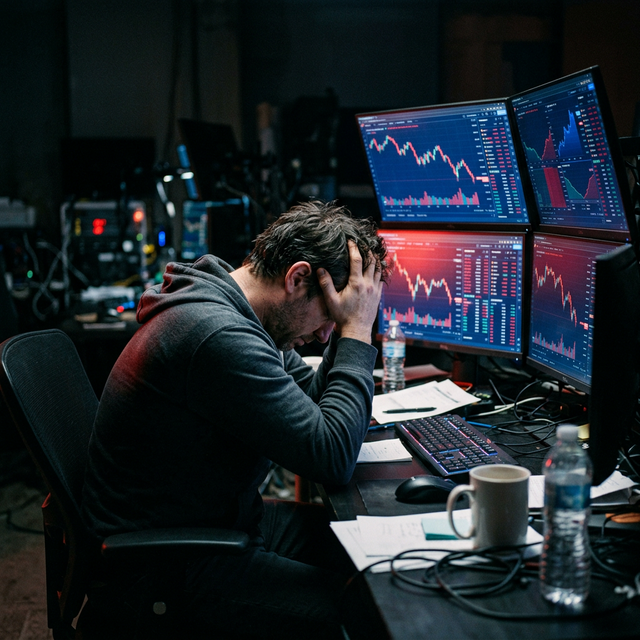
1. Why Drawdown Breaks Traders
Drawdown is the most psychologically destructive force in trading.
It's not the losing trade that kills your account — it's what you
do after the losing trade. When your equity curve starts
declining, a predictable cascade of emotional responses begins:
denial ("it'll come back"), bargaining ("just one more trade to
get even"), anger (revenge trading), and finally, capitulation
(blowing the account with oversized positions).
This isn't a character flaw — it's evolutionary biology. Your
brain treats financial loss the same way it treats physical
threat. The amygdala fires, cortisol floods your system, and your
prefrontal cortex (the rational decision-making center) literally
shuts down. You are physiologically incapable of making good
trading decisions when you're in fight-or-flight mode.
Understanding this is the first step toward defeating it.
lightbulb
Pro Tip
"The goal isn't to eliminate emotions from trading — that's
impossible and counterproductive. The goal is to create systems
that function correctly DESPITE your emotions. Your trading plan
should work even on your worst emotional day."
2. The Five Stages of Drawdown
Every experienced trader recognizes these stages. Understanding
where you are in this cycle is crucial because each stage requires
a different intervention strategy. The traders who survive
drawdowns are the ones who can step outside themselves and
objectively diagnose their emotional state.
Refusing to accept losses are real. "The market will reverse."
Anger at the market, your broker, or yourself for the losses.
"Just one more trade to get back to breakeven, then I'll
stop."
Doubling position size, abandoning stop losses, overtrading.
Stage 5: Recovery or Capitulation. This is the fork in the road. Traders who have pre-built systems (maximum
daily losses, mandatory cool-down periods, reduced position sizing rules)
navigate toward recovery. Those without systems capitulate — they blow
what's left of the account in a final, emotionally-driven gamble.
3. The Resilience Framework
Building psychological resilience isn't about willpower — it's
about architecture. You need to design your trading environment
and rules so that your worst-case emotional response still
produces an acceptable outcome. Here's the framework used by
traders who consistently survive drawdowns:
- Hard Daily Stop: Set an absolute
maximum daily loss (2% of account) that triggers automatic shutdown.
Write this on a sticky note on your monitor. No exceptions, no negotiations.
- Position Size Reduction: After
two consecutive losing days, automatically reduce position size
by 50% for the next three trading days. This prevents drawdown acceleration.
- The 24-Hour Rule: After any
loss exceeding 1% of account equity, take the next day off entirely.
Come back fresh with a clear mind.
- Pre-Session Journaling: Before
every trading session, write three things: your emotional state
(1-10), your plan for the day, and your maximum acceptable loss.
This activates your prefrontal cortex.
- Post-Trade Review: Grade every
trade on process (A-F), not outcome. A trade that followed your
plan but lost money is an "A" trade. A trade that made money but
broke your rules is an "F."
warning
Important Note
If you find yourself checking your P&L more than once per hour,
you are in an emotional state that is incompatible with good
trading decisions. Close your P&L display, set an alert for your
stop loss, and focus exclusively on execution quality. Watching
every tick of your unrealized profit is the fastest path to
irrational behavior.
4. Tactical Breathing & Biofeedback
This might sound unconventional, but the most effective immediate
intervention for trading anxiety is controlled breathing. Navy
SEALs use "box breathing" (4 seconds in, 4 seconds hold, 4 seconds
out, 4 seconds hold) to maintain calm during life-threatening
situations. If it works for combat, it works for drawdowns.
Several elite prop firms have begun incorporating biofeedback
devices that measure heart rate variability (HRV) as part of their
trader development programs. The data consistently shows that
traders with higher HRV (indicating better stress regulation) make
significantly fewer impulsive trades during drawdown periods. You
don't need expensive equipment — even a basic smartwatch can track
your heart rate during trading sessions, providing objective data
about your stress levels.
5. Cognitive Reframing Techniques
The most powerful long-term tool against drawdown anxiety is
cognitive reframing — changing how you interpret losses. Instead
of seeing a losing trade as failure, reframe it as data. Instead
of "I lost $500," think "my strategy's expected loss occurred
within normal parameters." This isn't positive thinking — it's
statistically accurate thinking.
- From "losing money" to "paying tuition": Every loss teaches something. If you can't articulate what a loss
taught you, that's the real problem — not the loss itself.
- From "I'm wrong" to "the setup didn't work": You are not your trades. Your identity should never be tied to
your P&L. Separate self-worth from trading performance.
- From "I need to recover" to "I need to execute": Recovery implies you're behind. You're not. Every trade exists
in isolation. Focus on the next execution, not the accumulated P&L.
6. Building Your Mental Edge
The traders who survive in this industry aren't necessarily the
best analysts or the most profitable scalpers — they're the ones
who can maintain psychological equilibrium through the inevitable
storms. Your edge isn't in your indicator settings or your entry
criteria. Your edge is in your ability to execute your plan
consistently, regardless of recent results.
Start today. Before your next trading session, spend 10 minutes
doing these three things: write down your maximum acceptable loss,
practice 5 rounds of box breathing, and honestly rate your
emotional readiness from 1-10. If your rating is below 6, don't
trade. The market will be there tomorrow. Your capital won't be if
you trade emotionally today.